
German Pilot Vanished During WWII — 79 Years Later, His Lost Fighter Was Found in Northern Italy
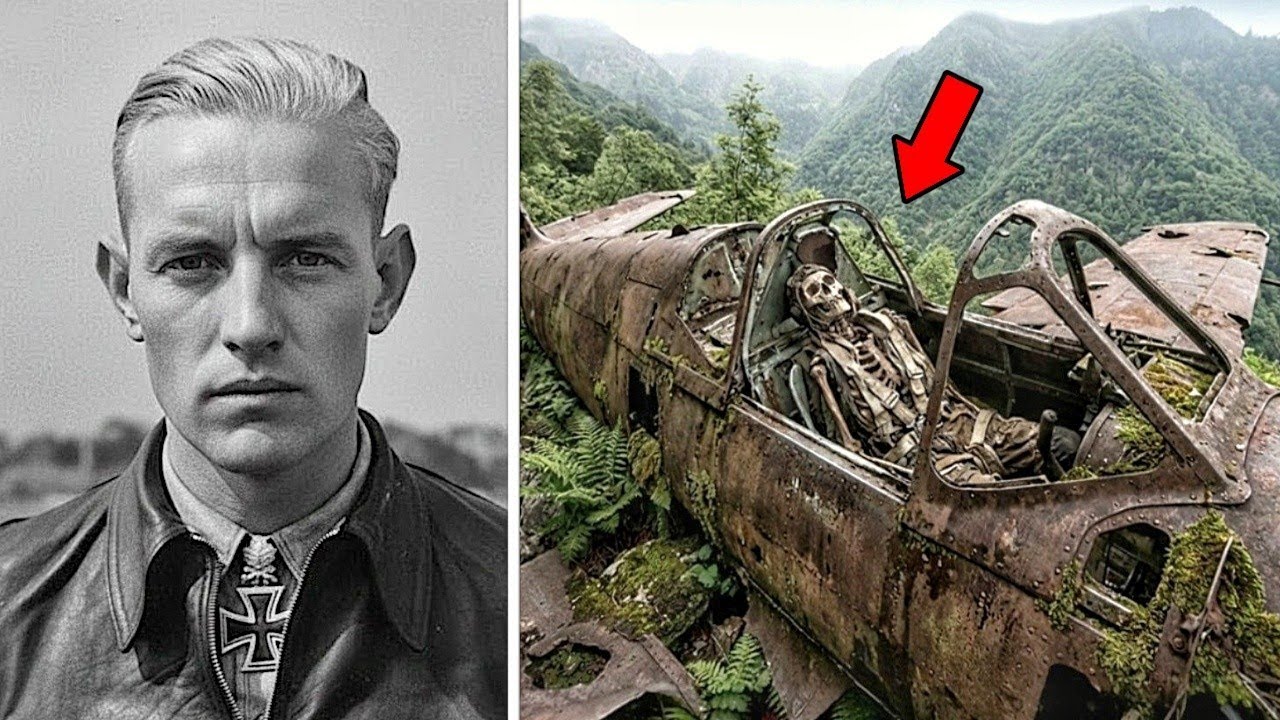
The wind moves strangely in the high valleys of the Italian Alps, thin, whistling, and cold even in summer. Locals say it carries voices if you’re up there alone long enough. Maybe that’s what pulled them off the trail. A group of hikers, seasoned and well-equipped, was making their way across a remote ridge line near Monte Zebru.
Something metallic caught the light through a break in the trees. At first glance, it looked like the jagged skeleton of a communications tower, or maybe old logging equipment, mangled steel wrapped in vines and brush. But as they pushed through the undergrowth, the shape began to clarify. A fuselage, wings, or what was left of them. A single iron cross, faded and flaking, was barely visible under a blanket of moss and rust.
One hiker stepped back, heart pounding. “Luftwaffe,” he whispered.
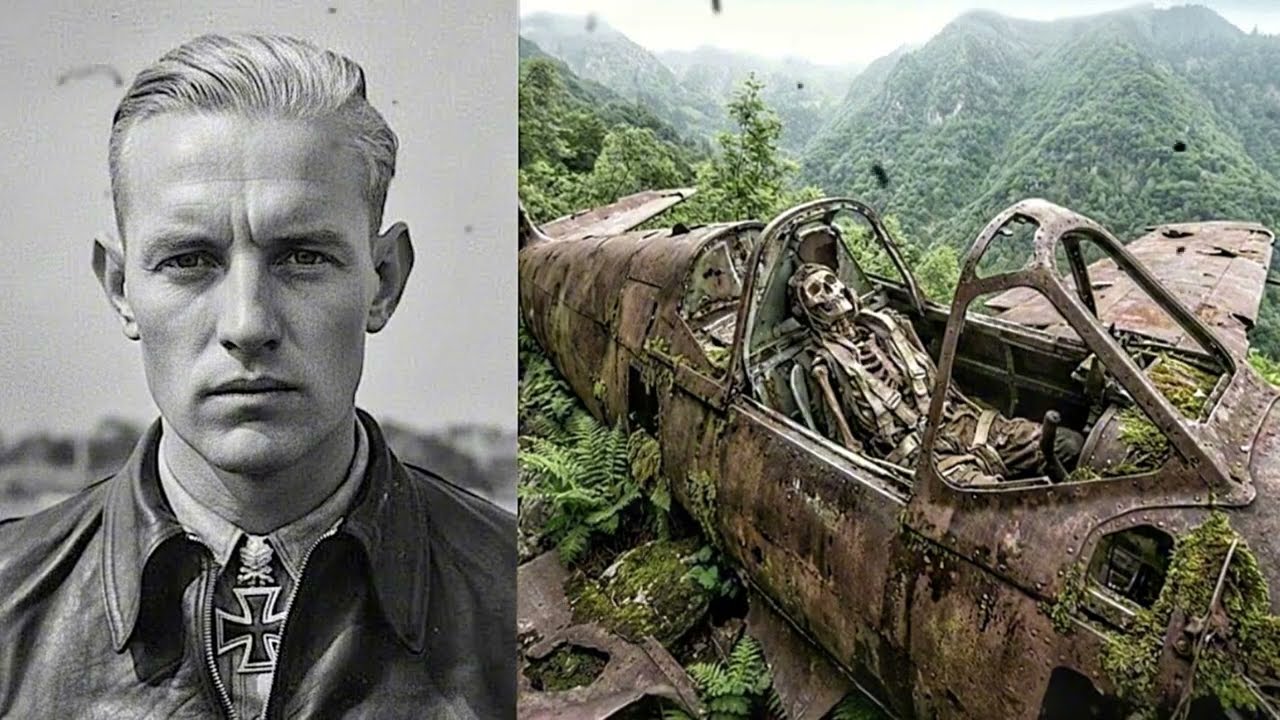
They had stumbled upon the ruins of a World War II era fighter plane, hidden in plain sight for nearly eight decades. Its nose was embedded into the slope, crushed inward from impact. The tail section was severed, resting several feet away. The canopy glass had long since shattered, but inside the cockpit, one thing remained. A skeleton still seated, still strapped in. The flight suit was brittle but intact, clinging to bones like a second skin. A helmet, half collapsed, rested against the seat. No animals had disturbed it. No one had found it before.
The air was thin and cold, but nobody spoke. There was only the faint hum of the wind brushing through the trees and the quiet horror of realizing they had uncovered a grave. The remains weren’t scattered. They weren’t buried. The pilot had died right there, alone, held upright by straps and silence. Time had sealed him inside his own wreckage and left him waiting.
The hikers called local authorities from a satellite phone. Within hours, the site was roped off and guarded. Italian Alpine rescue teams arrived by helicopter. Military historians followed. But long before the news broke, the forest already knew. It had held its secret for nearly 80 years. A whisper in the mountains, a body in a plane, a life erased and hidden under bark, bone, and rusted steel.
The headlines spread fast, carried by national papers and picked up across Europe. World War II fighter found in Alps, skeleton in cockpit. A team of forensic experts arrived on site before sunrise, escorted by local law enforcement and historical aviation specialists. What they found was far more preserved than anyone expected. The aluminum skin of the aircraft had been partially protected by the altitude and tree cover. Despite decades of storms and snowfall, the airframe, though battered, was unmistakable. A Messerschmitt BF 109, the workhorse of the Luftwaffe. The engine block was cracked, the propeller snapped in half, one blade buried deep in the soil like a monument.
But the cockpit was a time capsule. Inside, the skeleton remained strapped in, legs stiff against the rudder pedals, head slumped to the side. His gloves were still on. The leather had hardened and shrunk, fingers curled inward like they were still bracing for impact. Tucked under the seat, hidden beneath torn insulation, a metal disc was recovered—a soldier’s Erkennungsmarke, a dog tag. Stamped into the corroded metal were the words: Lieutenant Eric Clausner 3 JG27 1921.
A name lost to time, now spoken aloud again. He had been 24. Military archives were quickly scoured. Records confirmed Clausner as a pilot stationed in Austria during the final months of the war, assigned to the 27th Fighter Wing. He had flown out on a mission in March 1945 and never returned. Official status: missing in action. No crash site, no radio distress call until now.
Italian mountain police documented every detail. Soil samples, bone fragments, equipment. Historians took hundreds of photographs. Yet nothing explained how the aircraft had come to rest so deep in the wilderness, far from any known flight path. No burn marks, no explosion, just a sudden fatal end frozen in time. The plane would have been invisible from above, its muted shell blending with the rocks and trees. It wasn’t found because someone searched for it. It was found because someone happened to look down at the right moment. A ghost from the sky, hidden in the earth. Eric Clausner had never left. His war ended in silence, cradled by mountains that kept his secret for 79 years. Now, for the first time since 1945, his story was starting to rise from the wreckage.
March 14th, 1945. The war was already lost. It just hadn’t ended yet. Snow still clung to the edges of the cracked runways at Hörsching Airfield in northern Austria. Bomb craters pocked the perimeter. The fuel depot had been hit 2 days earlier. Mechanics worked with bare hands and salvaged parts. Morale was a ghost. And yet, flights still went up. Orders still came.
That morning, 24-year-old Leutnant Eric Clausner climbed into his BF 109 for what would become his final mission. He was one of the last pilots of Jagdgeschwader 27, a unit battered by attrition and desperation. His orders were to intercept Allied bombers approaching from the Adriatic, possibly en route to Munich. The skies over northern Italy had become a corridor of fire. P-51 Mustangs escorting B-17s, carving paths through shrinking German defenses. Clausner taxied slowly, watching the control tower shrink in the rear view mirror as he accelerated down the battered strip. Then with a low growl and a spray of half-melted snow, he lifted into the gray.
The mission log shows four aircraft launched that morning. Two turned back with engine trouble. The third returned hours later, trailing smoke. Clausner never came home. What happened over those jagged peaks remains conjecture. Allied bomber crews reported no kills. No dogfights were logged in the target area. Radar contact was lost somewhere south of the Austrian-Italian border in a stretch of terrain marked by steep ridges and unpredictable winds. No Mayday call was received. No flares. No wreckage reported by partisans or villagers. Clausner simply disappeared into cloud and silence.
In the hours that followed, nothing was said. His name was penciled onto the roster of the missing along with hundreds of others who vanished as the Reich crumbled around them. The commanding officer filed the report: presumed lost, no parachute observed, and that was it. No search was launched. Not in those final weeks when cities were falling and surrender was inevitable, fuel was rationed, resources were spent elsewhere. One pilot and one lost fighter was just another whisper in the noise of a dying war. Eric Clausner had gone up and never came back down.
After the war, the paperwork told its own version of the truth. In the official archives of the Bundesarchiv, Lieutenant Eric Clausner is listed as Vermisst seit März 1945—missing since March 1945. No burial, no confirmed kill, no wreckage. His status became a bureaucratic limbo, MIA. His name joined tens of thousands of others on lists that stretched across multiple nations. Soldiers claimed by war with no grave to mark the end.
His family, like so many others, was told what little there was to say. “Your son is missing in action. No further information is available.”
His mother reportedly kept his room untouched for years, hoping, like many grieving families, that he might somehow walk through the door, thin but alive, wearing the same crooked smile from his enlistment photo. But he never did. Decades passed. The world moved on. Germany was divided, then reunited. The Luftwaffe was dissolved, reborn. The mountains where Clausner fell were reclaimed by nature and memory. For the Clausner family, the silence was permanent. No bones to bury, no metal to polish, just absence. His niece, born long after the war, once said, “He existed only in stories. We had a photo, a name, and a date. That was all.”
Over time, most assumed the fighter had gone down over water. Perhaps the Adriatic had swallowed him. Perhaps the wreckage burned up on impact in some remote alpine gully buried by decades of rockfall and snow. In postwar investigations, his name barely registered—one of more than 30,000 German soldiers officially unaccounted for by the end of World War II. Too many ghosts to chase, too little evidence to follow. Unlike the soldiers buried in rows beneath white markers, Clausner’s absence became a kind of myth in itself. A lost pilot, a forgotten mission, a hole in the sky where a life once was. Families like his were told to move on, but grief doesn’t follow orders. For them, closure wasn’t a possibility. It was a luxury they were never granted. And so for 79 years, Lieutenant Eric Clausner remained missing, not dead, not alive, just gone until the mountain gave him back.
In a quiet town outside Munich, long after the war had ended, and the uniforms were folded away, Eric Clausner never truly left home. His black and white portrait stayed on the mantelpiece for decades, the edges soft from being handled too often. In the photo, he looks impossibly young, cap tilted slightly, eyes forward, unaware of the way his life would fracture into before and after. For his family, time did not erase him. It simply stretched the waiting. Letters were written year after year. First to the Red Cross, then to military archives, then to anyone who might still be listening. Each reply was the same, carefully worded and hollow: no new information available. His mother died without answers. His siblings grew old with questions they learned not to ask out loud.
But the stories never stopped. They were whispered at family gatherings, passed down like fragile heirlooms. “Eric in the clouds,” they called him. The pilot who flew into the sky and never came back. His niece, who was born decades after the war, remembers being a child and staring at the photograph, trying to imagine him alive. She says she used to think he was still up there somewhere, flying above the mountains, unable to land. No one ever corrected her. There was no grave to visit. No stone with a name carved into it. Without a body, mourning had no shape. It hovered unresolved. They never buried him because there was nothing to bury. No remains were returned. No coffin arrived. Just a telegram and silence. Over time, his absence became part of the family’s identity. A missing chair at the table, a name spoken in the present tense long after hope should have faded.
When the call finally came in 2024, telling them a plane had been found in the Italian Alps, the first response wasn’t relief. It was disbelief. After 79 years, they had learned not to expect endings. The crash site sat on a steep forested slope, far from any marked trail. Pines had grown around the wreckage, their roots curling through aluminum ribs and broken control cables like fingers reclaiming bone. From a distance, the aircraft was almost invisible, its dull, oxidized skin blending seamlessly with rock, bark, and shadow. Only when investigators stood directly above it did the shape become undeniable. A Messerschmitt BF 109 driven nose first into the mountain.
The impact had been violent. The cockpit glass was shattered inward, fragments still embedded in the seat frame. The nose cone was crushed, the engine torn partially free from its mounts. This was not a controlled descent. It was a high-speed collision, likely in poor visibility. The pilot never slowed enough to escape. He never bailed out. He stayed with the aircraft until the end.
What puzzled investigators most was the location. According to reconstructed flight paths, the fighter was miles off course deep into the Italian Alps, far beyond the expected interception zone. Maps from 1945 showed no reason for Clausner to be there. No strategic targets, no friendly airfields, just mountains, unpredictable winds, and cloud cover that could disorient even experienced pilots in seconds. The forest had protected the wreckage from discovery for generations. Snow covered it every winter. Fallen branches and soil buried it deeper each year. From the air, it looked like nothing. From the ground, it was a tomb. The skeleton inside remained seated, harness still locked, as if time itself had paused at the moment of impact. Eric Clausner didn’t vanish into legend. He didn’t disappear into the sea. He fell into the mountains, and the mountains kept him.
The wreckage was carefully dismantled piece by piece, each section logged, photographed, and preserved. What remained of the Messerschmitt was airlifted out in two helicopter loads, the forest watching quietly as it gave up what it had hidden for nearly eight decades. The remains were flown separately, under guard, in a sealed container marked only by an archival number. But everyone involved already knew who he was. Forensic pathologists at the Bundeswehr Institute in Koblenz examined the bones. The preservation was remarkable. Despite the exposure and time, the skeleton was largely intact. The teeth matched records from Clausner’s Luftwaffe medical file. His uniform, faded and mothed, still bore a pilot’s insignia and shoulder tabs from Jagdgeschwader 27. The dog tag confirmed what the mountain had always known. Lieutenant Eric Clausner, born 1921, fell here and never left.
The cause of death was as immediate as it was final—blunt force trauma to the skull and chest, consistent with a high-speed impact. There were no fractures indicating struggle, no signs of ejection, no parachute in or near the wreckage. The harness was still latched. The canopy release lever had not been pulled. He hadn’t tried to get out. He had ridden the plane all the way in. Aviation historians examined the fuselage and engine mountings. They confirmed a catastrophic failure, possibly fuel starvation or mechanical seizure in the supercharger. The propeller blades showed no sign of rotation on impact, suggesting the engine was already dead when the plane struck. But the question remained: why hadn’t Clausner bailed out?
The answer might have been simple. Visibility, clouds, altitude. By the time he realized the extent of the failure, there may have been no time, no clearance, and no hope. Or maybe he didn’t want to jump. Maybe he believed he could glide it down, find a clearing, make it home. Or maybe, like so many young men in the final months of the war, he had already made peace with whatever came next. Lieutenant Clausner’s bones were laid out with care, each one documented, each one accounted for. He had not disappeared. He had not become a ghost. He had remained exactly where he fell, preserved not by fate, but by silence.
Modern pilots have black boxes. Eric Clausner had paper, ink, and the steady discipline of a soldier trained to record the truth even when no one would read it. Tucked behind the pilot’s seat, wedged into the rusted frame beneath a crumpled survival kit, searchers recovered the shattered remnants of a flight log. The leather binding had rotted. Pages had fused together from moisture and age. But forensic archivists managed to separate and scan them. What they found offered the clearest insight yet into the final moments of Clausner’s life.
The entries were meticulous—times, headings, fuel status, brief comments in clipped German handwriting. The pen strokes faded, but still legible. The log began days before his last flight. Most entries were routine. Patrols, fuel loads, engine temperatures, but on the final page, everything changed. One line timestamped just after takeoff noted engine noise. Verdächtiges Rattern Vollgas—suspicious rattling at full throttle. Another line marked the onset of poor visibility. Dichte Wolken über Zielgebiet—heavy cloud cover over the target area. The writing becomes more compressed, less confident. There’s a scribbled correction. A pause, then the final entry. Treibstoff kritisch, Sinkflug, Sicht null—fuel critical, descending, visibility gone.
Nothing else. No signature, no coordinates, just those last six words. It wasn’t a farewell. It was a status report. Clausner had done what soldiers are trained to do. Record, assess, endure. Even when death was seconds away, there were no final thoughts, no poetic lines, just the cold mechanical truth of an aircraft dying in the sky and the man inside doing everything he could to stay ahead of it. But the mountain didn’t care. The clouds didn’t lift. The fuel ran dry. This fragment of paper, nearly lost to time and weather, became Clausner’s last message, more honest and human than any plaque could offer. There had been no chance for drama, no hero’s ending, just a slow, quiet fall into the pines, logged and unspoken, until the forest finally gave him back.
It took meteorologists and historians months to reconstruct the weather from that week in March 1945. Wartime reports, old Allied mission logs, and regional climate archives were pieced together to recreate the sky Eric Clausner had vanished into. What emerged was a snapshot of chaos above the Alps. Thick fog rolling through the valleys, sudden downdrafts, and a fast-moving snowstorm that formed without warning. The perfect storm for disorientation.
On that same day, Allied bomber squadrons were confirmed to have passed over the region bound for Munich and Innsbruck. Declassified mission reports detail their routes, altitudes, and contacts. Nowhere in the logs is there mention of enemy interception, no sightings of German fighters, no confirmed engagements. Clausner had been sent to meet them and never arrived. Flight historians speculated over the implications. The most likely scenario was a navigational failure compounded by weather and mechanical problems. The BF-109 wasn’t equipped with radar. Once inside heavy cloud, a pilot had only instinct and scattered glimpses of terrain through the mist. If his instruments began to fail, as the logbook suggests, and visibility collapsed around him, he would have been flying blind. Add a failing engine, low fuel, and the jagged teeth of the Italian Alps rising beneath him, and the outcome becomes terrifyingly inevitable.
Theories swirled, but one gained traction. Clausner got lost in the clouds, misjudged his location, and descended through dense fog, believing he was over safer ground. Instead, he plowed directly into the eastern slope of a forested ridge. Engine dead, speed unrecovered, no time to react. The cockpit glass told part of the story. It hadn’t shattered outward in an explosion. It had imploded from sudden impact. It wasn’t a dogfight. It wasn’t sabotage. It was a simple, brutal truth of aviation in war: one pilot, one failing aircraft, and a sky that offered no forgiveness. His mission had been over before the bombers ever passed overhead. While they flew on unchallenged, he lay in the pines, entombed in snow and steel, already part of the mountain before the last siren sounded.
Long after the war ended, the mountain said nothing. Seasons came and went, and the crash site grew quiet. Botanists brought in to study the scene estimated the slope had reforested naturally within two decades. Saplings sprouting between torn metal, roots curling around fractured struts, pine needles drifting down like snow year after year. By the 1970s, the wreckage was invisible from the air. Even hikers passing just meters away wouldn’t have seen it unless they looked straight into the trees at the right angle in the right light. What amazed the recovery teams most was the absence of disturbance. No scavengers, no sign of animals tearing at the site. No bones scattered, no cockpit looted. Even the logbook fragments tucked behind the seat remained exactly where they were left. Experts say the location was simply too remote, too high, too harsh for casual explorers. In winter, it was buried under meters of snow. In summer, cloaked by thick brush and difficult slopes, nature had built a fortress around it.
Soil samples taken beneath the aircraft showed layers of organic growth pressing down over decades, effectively sealing the lower fuselage like a time capsule. The scent of fuel and oil had long since faded. The forest had no reason to notice him. It simply grew around him, softly folding the debris into itself, turning metal and bone into part of the terrain. Unlike crash sites in more accessible locations—picked apart, picked over—this was pristine, a grave untouched not by reverence, but by isolation. The harness buckle was still fastened. His boots still aligned with the rudder pedals. Nothing had moved. Time had passed around him, but not through him. There were no prayers said, no witnesses, just wind, snow, and silence. The forest became his coffin, the wreckage, his tomb. It’s rare in modern times for the dead to remain completely undisturbed for so long, but Clausner did. For 79 years he lay alone in a machine that had become a monument marked not by stone or metal plaque, but by pine needles and silence.
In the villages that dot the lower valleys, old men sometimes spoke of a sound of strange clinking on certain windy days, as if chains or metal scraps were being stirred by the breeze high above the tree line. Shepherds passing through the region in the 1960s and 70s had heard it, they said, but never dared to investigate. The forest up there was thick, the trails unmarked, and the terrain unforgiving. Some said the sound was just wind in loose shale. Others whispered older things, tales of cursed ridges and voices that weren’t quite echoes. But no one ever climbed far enough to check. In 1987, an Austrian hiker named Markus Heisel published a map of the area after spending three seasons charting undocumented routes through the eastern Alps. On the eastern slope of Monte Zebru, he marked a patch of ridge line with a curious name: Zona del Silenzio, Zone of Silence. No paths crossed it, no landmarks stood out, just a shaded region and a note: unusual acoustics, a void in low visibility.
The map, out of print now, gathered dust in local outfitter shops until long after Clausner’s plane was found. What no one realized was that the Messerschmitt had been sitting inside that zone the entire time, hidden in plain sight, just meters off the natural ridge line, buried under decades of pine and stone. Military satellites had passed overhead. Hikers had passed beneath. Historians had studied flight paths and missions and terrain, but no one had looked there. Sometimes discovery doesn’t come from high-tech tools, or decades of analysis. Sometimes it comes from a wandering footstep, a curious eye, a flash of light off old aluminum. The wreck hadn’t moved in 79 years. What changed was someone seeing it.
The idea that so many passed so close without knowing became part of the story’s quiet heartbreak. Clausner hadn’t been lost in some distant unreachable corner of the world. He had been waiting just beyond the edge of attention. The German War Graves Commission took over immediately after identification was confirmed. Their mission, decades old, remained unchanged. Bring the fallen home. Eric Clausner’s bones, carefully cleaned and cataloged, were placed in a simple ceremonial casket draped in the black-red-gold of the German flag. The straps on his harness were cut with precision. His flight suit was folded and archived. His dog tag placed beside him, worn, but whole.
A helicopter crew prepared to lift the Messerschmitt’s remnants out of the crash site. The operation took place at dawn under thin clouds that mirrored the skies of 1945. Steel cables were attached to the shattered fuselage, and piece by piece the aircraft was lifted from the ridge where it had slept for so long. The sound of the rotors echoed across the forest, scattering birds, raising dust. Soldiers from the Bundeswehr stood at attention in a clearing below. Their salutes were silent, their expressions still. It wasn’t a grand funeral. There were no crowds, no speeches, just discipline and reverence, the kind owed to someone who had been lost longer than most people on the field had been alive.
The plane was slated for partial restoration—not to fly again, but to be displayed incomplete and honest in the Military Aviation Museum near Berlin. The team agreed unanimously. No reconstruction of the damage. The nose would remain crushed. The glass shattered, the seat empty. Visitors would see it as it was found. As it was flown. For his family, the return was both a wound reopened and a wound finally closed. Clausner’s casket was flown to Munich, where it was met by relatives holding photographs older than any living memory. His niece placed a letter inside before burial—unread, private, something only she and Eric would ever know. The long road home had taken 79 years. It crossed borders, outlasted governments, and waited in silence. But it arrived. One man, one plane, one story that was never truly lost, only waiting to be found.
Among the documents recovered during the investigation was a small weathered folder found tucked inside the lining of Clausner’s flight suit, sealed, forgotten, but still legible after all these years. Inside were two folded letters carefully penned in tight looping script. One was addressed to a comrade—never mailed. The other to his mother bore a date scrawled just two days before his final flight. The paper trembled in archivists’ gloved hands as they read it aloud for the first time in nearly eight decades. Clausner’s words were careful, deliberate, but carried the weight of quiet dread.
“Mother, if I fall, I hope the sky carries me gently. I will think of home as I rise.”
It wasn’t a goodbye. It was something softer, something between resignation and hope. In the margin, almost as an afterthought, he had written, “Don’t worry, I always come back.”
Military historians traced the letter’s origin back to a temporary Luftwaffe barracks near Hörsching. The base, long since demolished, had been Clausner’s final posting. He had likely written it in a cold bunk under dim light, just hours before flying into the storm that would erase him from the world. When the local council in Stelvio was approached about creating a memorial at the crash site, they asked the family what should be engraved. The niece, now an old woman with her uncle’s photo still framed in her home, sent one line from that letter. It was carved into stone with care. If I fall, I hope the sky carries me gently. The plaque sits near the ridge, bolted to a rock overlooking the slope, where the plane still left a scar in the earth. Not dramatic, not polished, but real. Now hikers stop. Some pause to read the inscription. Others just sit for a while and watch the trees sway. The wind up there is cold and strange. It carries no answers, no voices, but every now and then it moves through the pines just right, and it sounds like memory.
The trail to the crash site was never formalized. It winds loosely off an old shepherd’s path, marked only by a few stones and the occasional ribbon tied to a branch. But people find it. Word spreads quietly. Locals from nearby villages, many of whom grew up hearing legends about the sound of metal in the trees, have begun making the journey up one by one. At the edge of the slope, just above the scar in the forest floor, a simple stone marker was raised. It bears Clausner’s photo in uniform, weatherproofed and mounted beside the engraved plaque. His eyes stare out, young and calm, untouched by war or time. The expression is not triumphant, not tragic, just human. There are no flags, no politics, just stone, silence, and memory. Visitors leave things. A white rose, a smooth pebble with a date scratched into it. Someone tucked a folded paper crane into the branches of a nearby pine. One hiker, unknown, brought a knife and carved into the wood of a fallen tree: found at last.
Crazy also. No one disturbed it. No one painted over it. It remains, faded by sun and snow, the final line of a story that took nearly a century to write. The forest is quiet again. No more search parties, no more theories, just wind through trees, a rusted fragment of wing half buried in moss, and the long, slow breath of a mountain that waited nearly 80 years to speak. It never revealed its secret in a rush. It gave it up in pieces. Metal, bone, a line in a log book, a letter never sent. But in the end, it gave him back. Eric Clausner didn’t become a legend or a myth. He became something rarer: a soldier remembered, a mystery closed, a name returned to the earth with dignity. The mountain kept its secret until it was time to let go.
It was never meant to be found. The forest had decided that long ago. For 79 years, the crash site remained untouched. A secret folded into bark and soil, hidden by time and chance. The war ended, borders changed, families aged, and the world moved forward. But somewhere in the cold stillness of the Italian Alps, a fighter plane lay broken, and a pilot remained waiting in his seat, unnamed, unclaimed, and unseen, until one hiker stepped off the trail. It wasn’t part of the plan, just a moment of curiosity, a flash of sunlight off twisted metal, a shape that didn’t belong in the undergrowth. But that step undid nearly eight decades of silence. It opened a door no one expected, and through it walked Eric Clausner, not as a myth or mystery, but as a man, a soldier with a name, a family, a story too long untold.
He is not missing anymore. The paperwork now lists a date of death. The German War Graves Commission has marked him as recovered. His family has a grave to visit. The museum has his name. His log book has been archived, and his final letter is preserved under glass. The stone on the ridge bears his words. The forest, having kept him so long, finally let him go. And the silence, it’s different now. Where once there was only emptiness, there is memory. Where once there was a vanished flight, there is a known resting place. People come and stand by the marker. They speak quietly or not at all. Some read his name. Others only close their eyes and listen to the wind. The place is no longer just a patch of trees. It is a point on the map where something once disappeared and then was found again. Clausner’s story didn’t end in the sky. It ended here on a forested slope among pine and stone, with boots still on the pedals and hands still resting where they fell. No longer scattered, no longer lost. He went up into the clouds and for 79 years he stayed there. But now finally he has come home.
This story was brutal. But this story on the right hand side is even more insane.
