
The morning of June 15th, 2009 in Grand Canyon National Park, Arizona was clear and warm, promising to be a hot day.
Emily Harper, a 34year-old nurse from Phoenix, and her 12-year-old son, Nathan, stood at the edge of the south rim of the canyon, admiring the majestic view of one of the most impressive natural monuments on the planet.
A mile deep, miles of red orange rock layers, the Colorado River winding below like a silver ribbon.
A site that attracts millions of tourists from around the world every year.
It was a special trip for Emily and Nathan.
Their first trip together, just the two of them, mother and son, after Emily’s divorce from Nathan’s father a year ago.
Emily’s therapist advised her to spend quality time with her son to strengthen their bond after the difficult period of family breakdown.
Nathan had a hard time coping with the divorce, became withdrawn, and his grades at school dropped.
Emily hoped that this trip would help them both heal and start a new chapter in their lives.
They arrived the day before on June 14th and stayed at the Bright Angel Lodge on the south rim of the canyon.
The plan was simple.
Spend 3 days taking easy walks along the rim trails, photographing sunsets, talking, and rebuilding their closeness.
Emily specifically chose easy routes, the rim trail, and several lookout points.
No descents into the depths of the canyon where the trails become dangerous.
The temperature rises to 50° C, and the risk of heat stroke or falling increases many times over.
On June 15th, after breakfast at the hotel around 9:00 in the morning, Emily and Nathan went for a walk.
Emily told the receptionist, Jennifer Collins, that they plan to walk about 5 km along the rim trail to the Matherpoint Lookout, then return for lunch.
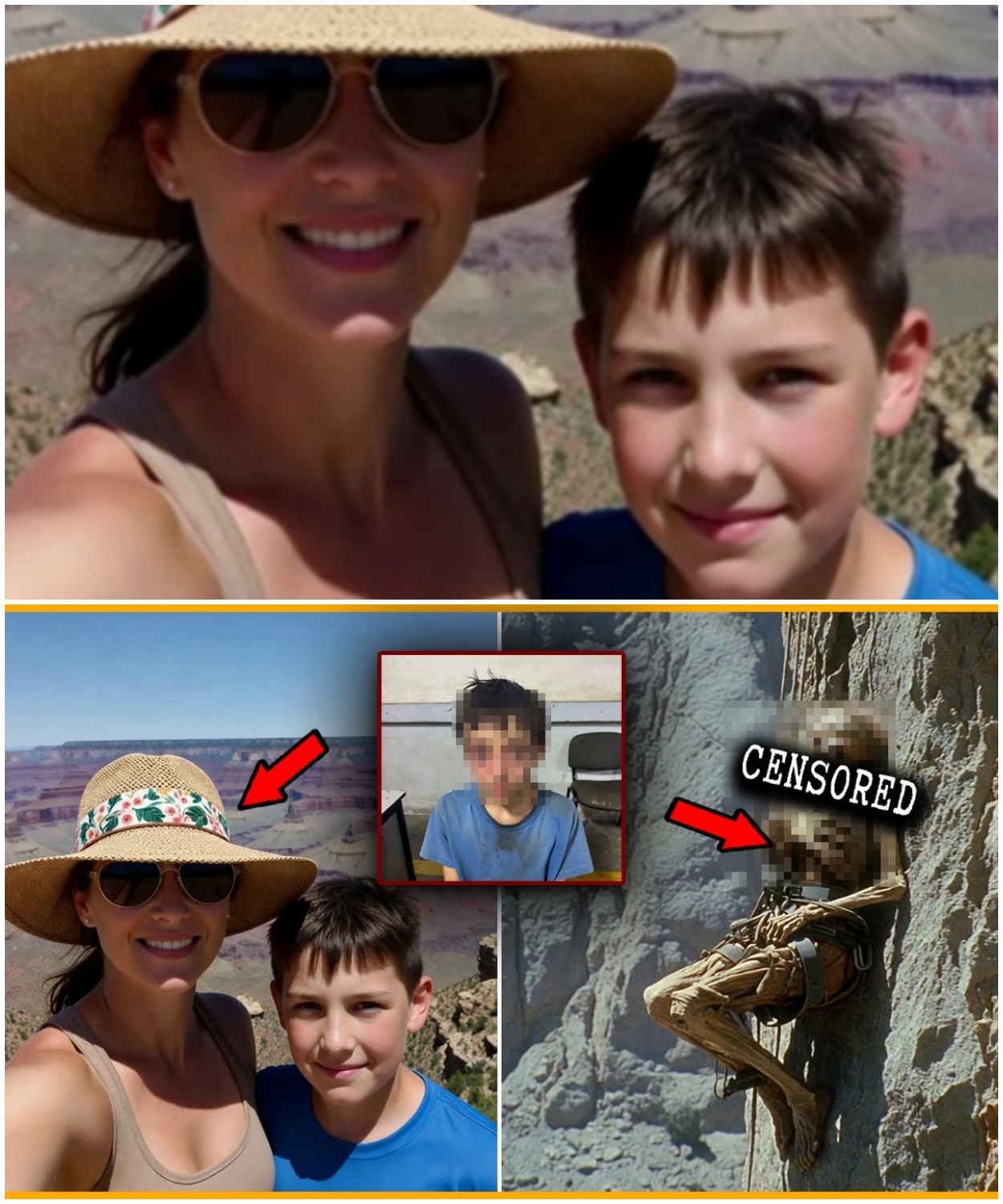
We’ll be back by 2:00, Emily smiled.
Nathan smiled, too, his first genuine smile in months, Jennifer later noted in her police statement.
They were last seen alive around 4:30 p.m.
at the Yavapai Point Lookout about 2 miles from the hotel.
A tourist from California, Robert Macintosh, happened to photograph them.
They were in the background of his family photo.
In the photo, Emily and Nathan are standing by a stone fence, Emily pointing something out to her son, indicating the canyon.
A typical tourist scene.
Nothing foreshadowed the tragedy.
When Emily and Nathan did not return by 6:00 p.m., the manager, Jennifer, began to worry.
Emily seemed like a responsible woman, not the type to be late without warning.
By 7:00 p.m., when they still had not appeared, Jennifer called the Rangers.
Ranger Thomas Wilson arrived at the hotel 15 minutes later.
He checked Emily’s room.
It was empty.
Their belongings were there, and the beds were made.
Emily’s car, a gray Honda Accord, was in the hotel parking lot.
Their backpack was found in the room, which meant they had only taken a small bag with water and snacks.
Their cell phones were also in the room.
Emily had left them there, not wanting technology to distract her from spending time with her son.
This was the first alarming circumstance.
Without phones, without the ability to communicate, if something happened, they couldn’t call for help.
Wilson immediately organized an initial search.
A group of six rangers walked along the rim trail, checking lookout points and questioning tourists.
No one had seen Emily and Nathan after 4:30 p.m.
No one had heard cries for help.
No one had noticed anything unusual.
By 1000 p.m., when it got dark and the search had to be suspended until morning, the rangers began to consider the worst case scenarios.
Grand Canyon National Park is dangerous.
An average of 12 people die here every year.
Falls from the edge, heat stroke during descents, heart attacks on steep trails, and rarely attacks by wild animals.
But Emily and Nathan were on a simple, safe rim trail.
What could have gone wrong? On the morning of June 16th, a large-scale search operation was launched.
more than 40 rangers, volunteers, helicopters with thermal imaging cameras, search dogs.
They combed every meter of the rim trail and the surrounding area.
They checked the ledges below the rim.
Perhaps someone had fallen.
They descended into side crevices and looked behind rock ledges.
Nothing.
No traces, no bodies, no signs that Emily and Nathan had ever existed.
After 4:30 p.m.
on June 16th, the investigators began to dig deeper.
They checked Emily’s background, her connections, her enemies, her debts.
Emily was a divorced single mother who worked as a nurse at St.
Joseph’s Hospital in Phoenix.
She lived modestly and had no financial problems.
The divorce had been relatively amicable.
Her ex-husband, David Harper, had been granted joint custody of Nathan, paid child support, and their relationship was cold, but not hostile.
But further investigation revealed an interesting detail.
A month before the trip, on May 14th, 2009, Emily broke up with her boyfriend Claude Reed, a 38-year-old mechanic from Tempe, a suburb of Phoenix.
They had been dating for about 5 months, having met on a dating site.
At first, everything was fine, but then Reed began to show signs of possessive behavior, jealousy, and control.
According to the testimony of Emily’s friend, Sandra Mitchell, whom investigators contacted, Reed began to constantly call Emily, check where she was and who she was with, and demand access to her phone and email.
When Emily tried to set boundaries, he became aggressive.
Once in early May, after an argument, he grabbed her wrists so hard that he left bruises.
That was the last time.
Emily broke off the relationship and told him not to contact her anymore.
But Reed did not leave her alone.
Investigators requested Emily’s phone records from her provider.
They found that between May 14th and June 14th, Reed had called her 73 times.
Most of the calls went unanswered.
They also found text messages at first pleading, “Give me another chance.
I love you.
I’ll change.
” Then more aggressive ones.
You can’t just walk away from me.
We need to talk.
I’ll find a way to make you listen.
The last message was sent on June 12th, 3 days before her disappearance.
You think you can ignore me? I’ll find you.
We’ll talk in person.
I promise.
This immediately made Claude Reed the prime suspect.
On June 17th, detectives from the Cauanino County Sheriff’s Office went to Tempe to question him.
But when they arrived at his apartment, Reed was not there.
Neighbors said they hadn’t seen him in several days.
His car, a black Dodge Ram, was also gone.
Detectives obtained a search warrant for the apartment.
Inside, they found printouts of pages from Emily’s social media accounts, including her recent post about a planned trip to the Grand Canyon with Nathan.
Reed knew where she would be.
An arrest warrant was issued for Claude Reed on suspicion of kidnapping.
His photo was sent to all law enforcement agencies in Arizona and neighboring states.
The APB apprehend person bulletin included a description of his car, but neither Reed nor his car were found, and Emily and Nathan were still missing.
Days passed.
The search in the Grand Canyon continued, but with each passing day, hope faded.
In the desert climate of Arizona, with daytime temperatures above 40° C, a person without water can survive for a maximum of 3 to 4 days.
By June 20th, the fifth day after their disappearance, rangers began searching for bodies rather than living people.
Emily’s mother, Catherine Stone, flew in from Seattle.
She gave tearful interviews to the media, begging anyone who had seen her daughter and grandson to contact the police.
Emily’s ex-husband, David Harper, also arrived, joined the search, walked miles of trails, shouting his son’s name, hoping for a miracle.
And a miracle happened, but not in the way everyone expected.
On the morning of June 25th, 2009, 10 days after the disappearance, Ranger Maria Sanchez was patrolling a service road in a deserted area about 12 km east of South Rim.
It was a little used road leading to the park’s technical facilities closed to ordinary tourists.
Around 10:00 in the morning, she saw a figure walking along the road.
a child, a boy of about 12, wearing a dirty t-shirt and shorts, barefoot, limping.
The skin on his face and hands was red from sunburn.
His lips were cracked and bleeding.
He walked slowly, as if each step was difficult, but persistently toward the main road.
Sanchez stopped the car and jumped out.
“My God, child, are you okay?” The boy looked up at her.
His eyes were sunken and dehydrated, but his mind was clear.
He opened his mouth and whispered horarssely, “Help, my mother.
” Sanchez immediately called for medical assistance and gave the boy water from her canteen.
He drank greedily, choking.
“What’s your name?” she asked gently.
“Nathan,” he replied.
“Nathan Harper.
” Sanchez felt a chill.
A missing boy.
She hugged him, trying to maintain her professional composure, but tears streamed down her cheeks.
You’re safe now, Nathan.
You’re safe.
A helicopter evacuated Nathan to the Grand Canyon Medical Center 20 minutes later.
Doctors immediately began treatment.
Introvenous fluids for rehydration, treatment for sunburn and abrasions on his feet, and testing for heat stroke.
Physically, Nathan was in surprisingly good condition considering the circumstances.
Dehydrated, exhausted, sunburned with cuts on his feet from walking barefoot on rocky terrain.
But alive.
Alive.
Detective Sarah Coleman arrived at the medical center an hour later.
She began to ask questions cautiously, taking into account the boy’s condition and the presence of a child psychologist.
and what Nathan told her turned the missing person case into a murder case.
According to Nathan, on June 15th at around 5:00 p.m., as he and his mother were walking along a trail near Yavapai Point, a man approached them.
He was tall with dark hair, wearing sunglasses and a baseball cap.
Nathan didn’t recognize him at first, but his mother did.
Her face pald, and she instinctively stepped forward, shielding Nathan with her body.
Clawed,” she said quietly, fearfully.
“What are you doing here?” The man smiled, but it was a cold, unpleasant smile.
“Hello, Emily.
Long time no see.
We need to talk.
” Emily shook her head.
“We have nothing to talk about.
Please go away.
Nathan is here.
” Claude looked at the boy, then back at Emily.
“That’s exactly why we need to talk.
Family matters.
Let’s go over there.
” He pointed to a side path leading to a less frequented observation deck away from the main route.
“No,” Emily said firmly.
“We’re leaving.
Come on, Nathan.
” She took her son’s hand and tried to walk past Claude.
He grabbed her other hand and squeezed it hard.
I said, “We need to talk.
Don’t make me do this here.
” There was a threat in his voice that even Nathan, a 12-year-old child, could sense.
Emily looked around.
The trail was empty at that moment.
Most of the tourists had already left for their hotels for dinner.
The nearest people were far away around the bend.
She looked at Nathan, then at Claude.
Okay, we’ll talk, but Nathan is staying here.
No, Claude objected.
He’s coming with us.
I don’t trust you not to run away.
He dragged Emily to a side trail, Nathan following them, frightened, not knowing what to do.
They turned onto a narrow path that led to a small ledge with a bench, a place to rest with a view of the canyon.
It was completely deserted, no one around.
Claude turned to Emily, still holding her hand.
“Why are you ignoring me? Why aren’t you answering my calls?” Because we broke up, Claude, Emily said, trying to free her hand.
It’s over.
Please let me go and leave us alone.
His face contorted with rage.
It’s over.
You don’t decide when it’s over.
I decide.
He swung and hit her, a hard punch to the face.
Emily fell, blood pouring from her nose.
Nathan screamed.
Claude turned to him and hissed.
Shut up.
If you scream again, I’ll throw your mother off this cliff right now.
Nathan fell silent, tears streaming down his cheeks, but he didn’t make another sound.
Claude lifted Emily, who was holding her face and moaning in pain.
He dragged her to the edge of the ledge where the trail ended, giving way to a steep slope with rocky ledges below.
“See that ledge over there?” he asked, pointing down about 3 or 4 meters below the main trail.
You’re going to climb down there.
And you’re going to sit quietly until I decide what to do with you.
Claude, please.
Emily begged.
Don’t do this.
Please.
Nathan is here.
Don’t scare him.
Claude hit her again, this time in the stomach.
She doubled over, gasping for breath.
He pulled off his leather belt and tied her hands behind her back.
Then he forced her down onto the ledge, pushing her until she slid down and landed on the stone shelf with a painful groan.
The ledge was narrow, about a meter wide, with a stone wall behind it and a cliff in front.
Emily couldn’t climb back up with her hands tied.
She was effectively trapped.
Claude looked at Nathan.
You saw where your mother is.
If you tell anyone, if you try to call for help, I’ll come back and push her off.
Understand? Nathan nodded, trembling all over.
Good boy.
Now go.
Get out of here.
Go back to the hotel or wherever you want.
But if you tell anyone, your mother will die.
Nathan stood there paralyzed with fear.
Claude shouted, “I said go.
” Nathan ran.
He ran down the path, tears blurring his vision, his heart pounding.
He ran until he reached a fork where a side path joined the main one.
There he stopped trying to decide what to do.
Call for help.
But then that man would kill his mother, go back to the hotel.
But how could he leave his mother there alone, tied up? Nathan was a 12-year-old child, lost, frightened, not knowing what to do.
In the end, he decided to try to rescue his mother himself.
He waited until Claude left, then returned to the side path.
But when he reached the ledge, he saw that it was impossible to climb down to his mother.
It was too steep, too dangerous.
He could fall.
He tried to find another way.
He took a detour, hoping to find a way to approach the ledge from below or from the side, but he got lost.
The desert terrain of the Grand Canyon is complex with many similar rock formations, and it is easy to lose your bearings.
By the time it got dark, Nathan realized he was lost.
The next nine days became a test of survival for the 12-year-old boy.
He wandered through the desert trying to find his way back to his mother or to people.
His sneakers fell apart on the third day, and he continued barefoot.
He drank water from rare streams and puddles after the one time it rained.
He ate edible plants that he had seen his mother point out during previous hikes.
prickly pear cactus fruits, some berries.
He hid from the sun in the shade of rocks during the hottest hours of the day.
Several times he heard search and rescue helicopters and tried to wave and shout, but they flew past, not noticing the small figure among the endless rocks.
On the ninth day, he came out onto a service road where Ranger Sanchez found him.
Detective Coleman listened to Nathan’s story, writing down every detail.
When he finished, she asked gently, “Nathan, can you describe this man? What was he like?” Nathan described Claude Reed as accurately as a 12-year-old child could remember.
Tall, dark-haired, with a rough voice, wearing a black t-shirt and jeans and sunglasses.
“And your mother called him Claude,” Coleman clarified.
Nathan nodded.
“Yes,” she said, “Claude when she saw him.
” This confirmed their suspicions.
Claude Reed, now not just a suspect in the kidnapping, but a suspect in the murder.
Because Emily couldn’t have survived 9 days on that ledge without water, without food, tied up under the scorching desert sun.
The investigators knew they would almost certainly find her dead.
Nathan gave a fairly accurate description of the location of the ledge, a side trail from Yavapai Point heading west about 500 m.
A search party was dispatched immediately.
2 hours later at 5:30 p.m.
on June 25th, they found her.
Emily Harper was lying on a narrow rock ledge about 4 m below the side trail.
Her body was in a fetal position, her hands still tied behind her back with a belt.
Her skin was dark from the sun and the early stages of decomposition.
Her eyes were closed.
There was no water, food, or protection from the elements near her.
The medical examiner later determined that Emily had lived on the ledge for about 4 to 5 days.
The cause of death was a combination of dehydration, heat stroke, and injuries from beating, including internal bleeding from a blow to the abdomen.
She did not fall.
She did not slip.
She died slowly and painfully on that ledge, knowing that her son was somewhere out there, possibly dying, too, and there was nothing she could do about it.
It was one of the most tragic scenes that experienced rangers and investigators had ever seen in their careers.
Detective Coleman cried as Emily’s body was lifted from the ledge.
Even the hardened rescuers couldn’t hold back their tears.
Meanwhile, the hunt for Claude Reed had gone national.
The FBI joined the investigation, classifying the case as an interstate homicide.
Reed’s photo was on all the news channels, on the internet, and on wanted posters across the country.
The breakthrough came on June 26th.
Security cameras at one of the Grand Canyon parking lots captured Reed’s black Dodge Ram parked on the far side of the Desert View parking lot about 6 kilometers from the crime scene at 4:45 p.m.
On June 15th, the time coincided with the attack.
The vehicle remained there until June 17th, then drove away.
Additional checks of cameras at the park exits showed that Reed’s pickup truck left the Grand Canyon on the evening of June 17th, heading towards Nevada.
Alerts were sent to all Nevada police departments.
At 11:00 a.m.
on June 27th, a Nevada Highway Patrol officer stopped a black Dodge Ram for speeding on Highway 93 near the town of Caliente.
A check of the license plate revealed that it was Claude Reed’s vehicle.
The officer called for backup and arrested Reed without resistance.
Reed was extradited back to Arizona.
A search of his pickup truck revealed additional evidence.
Dust and dirt were found in the trunk that matched soil samples from the trail where the crime was committed.
A second leather strap was found, identical to the one used to bind Emily’s hands.
Reed apparently carried two straps, using one for the binding and keeping the other for himself.
A baseball cap and sunglasses matching Nathan’s description were also found in the back seat.
The glasses had Reed’s fingerprints and microscopic blood spatters, which DNA analysis determined belonged to Emily.
During questioning, Reed denied everything.
He claimed that he was not in the Grand Canyon on June 15th, that he had last seen Emily a month ago, and that he had no idea what the police were talking about.
But the evidence was irrefutable.
Nathan’s testimony as a direct witness.
CCTV footage showing Reed’s car in the park on the day of the crime.
Physical evidence from the car.
A history of threats and obsessive messages.
Reed’s knowledge of Emily’s plans through her social media.
Cookanino County District Attorney James Anderson charged Claude Reed with first-degree murder, kidnapping, and aggravated assault.
He sought the death penalty.
Arizona was one of the states where capital punishment was still in use.
The trial began in March 2011, almost two years after the crime.
Nathan, now a 14-year-old teenager, testified.
His voice trembled.
Tears streamed down his cheeks, but he recounted everything he had seen and remembered.
The defense tried to undermine his testimony, arguing that the child could have been mistaken, confusing details after the traumatic experience of wandering in the desert for 9 days.
But other evidence corroborated every word Nathan said.
The prosecutor presented Reed’s threatening correspondence.
He showed the trajectory of his car on camera.
He presented expert reports on the blood on the glasses, the soil in the car, and the match of the seat belt.
The defense could not present a convincing alibi.
Reed claimed he was at home in Tempe on June 15th, but could not provide any witnesses.
He claimed that someone had framed him, stolen his car, and returned it.
An absurd theory that the jury did not accept.
On April 19th, 2011, after 4 hours of deliberation, the jury returned a verdict.
Guilty on all counts.
first-degree murder, kidnapping, aggravated assault.
At the sentencing phase, the prosecutor sought the death penalty.
But Emily’s family, including Nathan, spoke out against it.
Emily’s mother, Catherine Stone, said in her statement to the court, “The death penalty will not bring my daughter back.
It will not heal the trauma Nathan has endured.
I want this man to spend every day until his natural death in prison thinking about what he has done.
Death would be too easy for him.
The judge took this opinion into account.
On April 26th, 2011, Claude Reed was sentenced to life in prison without the possibility of parole.
He is serving his sentence at the ASPC IMAN maximum security prison in Florence, Arizona, where the state’s most dangerous criminals are held.
For Nathan Harper, the story did not end with the sentence.
He lost his mother in the most horrific way.
Spent 9 days in the desert thinking that his mother might be dead and that he would be next.
The experience left deep psychological scars.
Years of intensive therapy helped, but the nightmares, post-traumatic stress disorder, fear of conflict, and trust issues remained.
His father, David Harper, gained full custody and did everything he could to help his son heal.
He sent him to the best psychologists and surrounded him with care and support.
By 2016, at the age of 19, Nathan had enrolled in college studying psychology with the intention of becoming a therapist for traumatized children.
“I want to help other children who have gone through something similar,” he said in an interview on local television.
“I want them to know that it is possible to survive, that life after trauma is possible.
” He also became an activist against domestic violence and stalking.
He speaks at conferences, tells his story, and urges people to take warning signs of aggressive behavior in relationships seriously.
The story of Emily Harper and Nathan became one of the most tragic cases in the history of Grand Canyon National Park.
It showed that danger does not always come from nature.
Steep slopes, wild animals, extreme heat.
Sometimes the greatest danger comes from people, from those who cannot accept rejection, who consider another person their property.
A small memorial plaque now stands at the Yavapai Point Overlook.
It reads in memory of Emily Harper, 1975 2009.
A loving mother, a dedicated nurse, a brave woman, her light lives on in her son and in all those she touched.
Every year on June 15th, Nathan comes there.
He stands by the plaque, looks at the majestic canyon, remembers the last day he spent with his mother.
He cries, he prays, and he promises to keep living, to keep fighting, to keep helping others, because that’s what his mother would have wanted.
Nathan’s survival story is a miracle.
a 12-year-old child alone for 9 days in one of America’s harshest deserts and he survived.
Survival experts say his chances were slim, but a combination of luck, basic knowledge of nature, and an incredible will to live saved him.
But it is also a story of horrific tragedy.
A woman who simply wanted to spend quality time with her son fell victim to her exartner’s obsession.
She died a painful death alone under the scorching sun, knowing that her child was lost somewhere in the desert.
This story is a reminder of the importance of taking threats, warning signs of domestic violence and obsessive behavior seriously.
Emily told a friend about Reed’s behavior, but she did not go to the police or get a restraining order.
Perhaps she thought he would just calm down and leave her alone.
Domestic violence organizations use this story in their educational campaigns.
They teach people to recognize the signs of a dangerous relationship and the importance of seeking help and legal protection.
The story has also been a lesson for Grand Canyon National Park employees.
Security measures have now been tightened with more patrols on the trails and additional surveillance cameras installed in parking lots and along major routes.
Rangers are trained to recognize signs of criminal activity and domestic conflicts among visitors.
Sitting in his prison cell, Claude Reed refuses to discuss the crime.
He does not give interviews or express remorse.
Other prisoners avoid him or mock him.
In the prison hierarchy, those who kill women are at the bottom.
He will spend the rest of his days in isolation alone, just as he left Emily to die on that ledge.
And Nathan Harper continues to live despite everything.
Because he survived for a reason, to tell the truth.
So that his mother would not be forgotten.
So that her death would have meaning in helping others.
His story is a testament to the strength of the human spirit.
The ability of a child to survive the unthinkable and still find a way forward.
It is a story of horror and hope, loss and survival, darkness and
