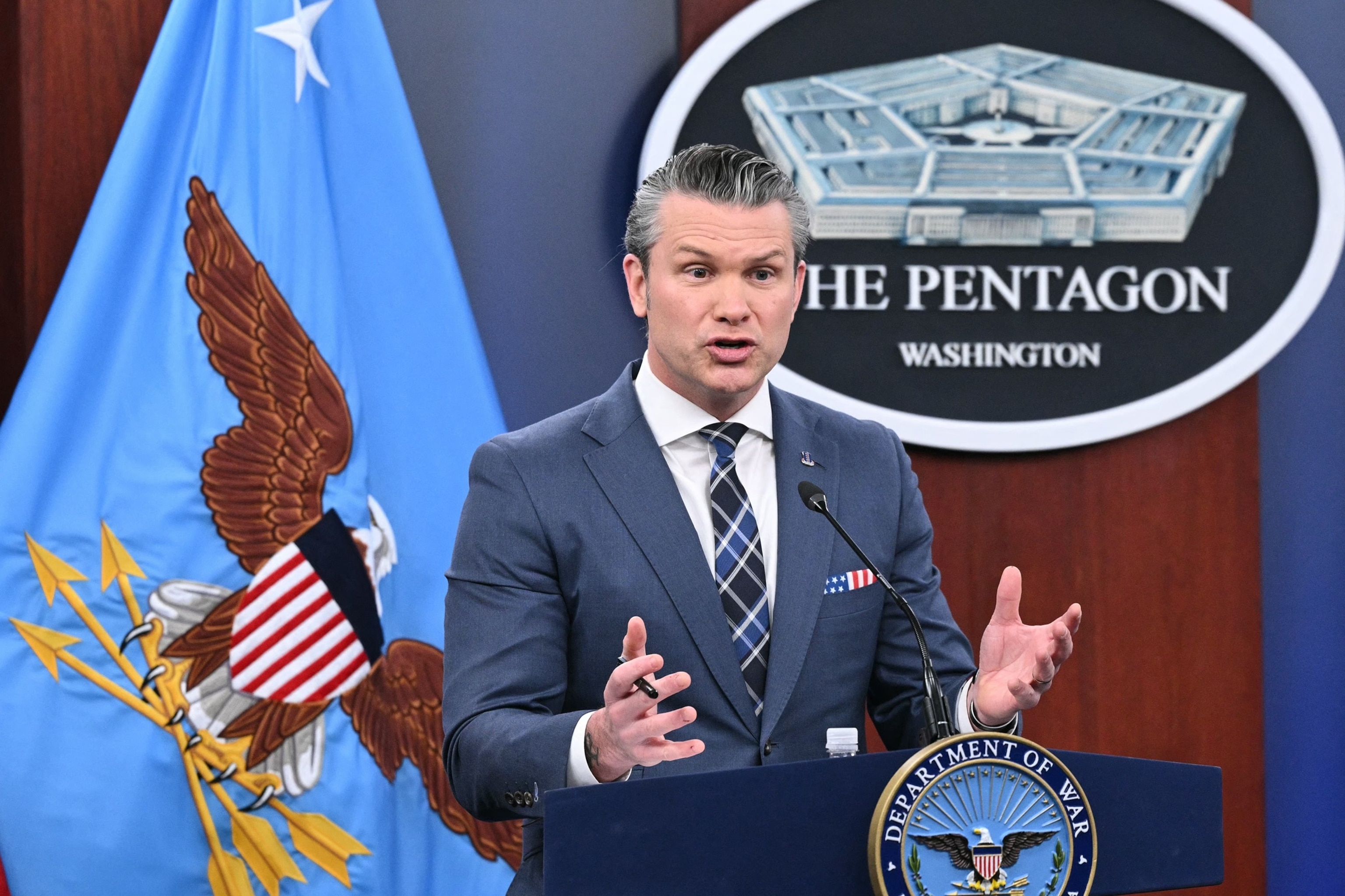
Asked about reports that the Pentagon sought an additional $200 billion from the White House in supplemental funding for the war, Secretary Pete Hegseth indicated that the figure could “move.”

“As far as $200 billion I think that number could move,” he said. “Obviously it takes money to kill bad guys. So we’re going back to Congress and our folks there to ensure that we’re properly funded.”
Iran has been a ‘threat’ to America ‘across every theater,’ Hegseth says
Secretary of Defense Pete Hegseth said Iran’s goal for decades has been targeting Americans around the world, saying the regime, has been a “threat” to American “across every theater.”
“They have been at war with us, whether we acknowledge it or not, for 47 years,” Hegseth said.

“What President [Donald] Trump would not tolerate is a regime of that nature being closer and closer to nuclear capabilities, a capability they would have said they would want to use,” Hegseth said.
Hegseth declines to set timeline of ending operation, but says ‘we’re on plan’
Asked how close the U.S. is to achieving President Donald Trump’s objectives in Iran, Secretary of Defense Pete Hegseth declined on Thursday to set a timeline.
“We wouldn’t want to set a definitive time frame on that, but as we’ve said, we’re on plan,” Hegseth said.

“You hear a lot of noise about widening or new missions, or speculation about what we should or should not be doing. This is a clear set of objectives. The president has given us every capability we need to accomplish that. We’ve got the best in the world in uniform, executing it on the ground,” Hegseth said.
Hegseth said the end of the war “will be at the president’s choosing.”
Secretary of Defense Pete Hegseth said during a press conference on Thursday that the world should be thanking President Donald Trump for fighting this war against Iran.

He broadly characterized America’s European allies as “ungrateful,” saying they should be among those thanking Trump for “the courage to stop this terror state from holding the world hostage with missiles while building or attempting to build a nuclear bomb.”

Hegseth described Iran’s current and former leaders, saying, “Their core industries [are] not steel or agriculture, tourism, their core industries are state-sponsored terrorism, proxy militias, underground networks, ballistic missiles and a violent, messianic Islamist ideology chasing some sort of apocalyptic end game.”
“A regime like that refusing to abandon its nuclear ambitions is not just a regional problem, it’s a direct threat to America, to freedom and to civilization the world, the Middle East, our ungrateful allies in Europe, even segments of our own press should be saying one thing to President Trump, ‘Thank you,'” Hegseth said.
Secretary of Defense Pete Hegseth said the U.S. will be hitting Iran with its largest strike of the conflict on Thursday.
“Iran has funneled decades of state resources not to their people but into missiles and drones and proxies and buried facilities, but we are hunting them down, methodically, ruthlessly and overwhelmingly like no other military in the world can do,” Hegseth said at a Pentagon briefing on Thursday.

Hegseth said over 7,000 targets across Iran and its military infrastructure have been struck since the conflict began with joint U.S. and Israeli strikes on Tehran on Feb. 28.
“Their ability to manufacture new ballistic missiles has probably taken the hardest hit of all ballistic missile attacks against our forces down 90% since the start of the conflict. Same with one way attack UAVs,” Hegseth said on Thursday.
Secretary of Defense Pete Hegseth said he joined President Donald Trump at Dover Air Force Base in Delaware on Wednesday to honor the six service members killed when their KC-135 refueling aircraft crashed in western Iraq last week.

“We grieved with their families, and we listened what I heard through tears, through hugs, through strength and through unbreakable resolve. Was the same from family after family, they said, ‘Finish this. Honor their sacrifice. Do not waver. Do not stop until the job is done,'” Hegseth said at a Pentagon briefing Thursday.
“My response, along with that of the president, was simple, of course, ‘we will finish this. We will honor their sacrifice,'” Hegseth said.
An Iranian drone struck a Saudi Aramco refinery in Yanbu, on the Red Sea, on Thursday, according to the Saudi Ministry of Defense.
“A drone fell in the Samref refinery and the damage is being assessed,” the ministry said in a statement.

Iran’s Islamic Revolutionary Guard Corps had issued warnings for several Gulf energy production sites, including the refinery in Yanbu, after Wednesday’s Israeli strikes on the South Pars Gas Field, the largest in Iran.
Kuwait earlier on Thursday said an Iranian drone had struck one of its refineries.
-ABC News’ Lama Hasan and Zoe Magee
Strikes by Iran on Gulf nations’ energy production facilities pushed oil and gas futures higher in volatile trading on Thursday.
The benchmark for European gas surged by about 24% after Iran on Wednesday released retaliatory strikes targeting energy sites in the Gulf.

Qatari authorities said Iranian ballistic missile attacks caused fires and “extensive damage” at the Ras Laffan terminal, which carries about a fifth of global liquid natural gas. Kuwait also on Thursday said one of its refineries had been struck by a drone. Those attacks came after Israel on Wednesday targeted Iran’s largest gas field.
The Dutch Title Transfer Facility, which is widely seen as the European benchmark for natural gas, saw forward-looking contracts for next month climb about 24% in midmorning trading on Thursday.
Brent crude oil prices, which are also a benchmark for global trading, climbed by about 6%, hitting $116 per barrel for contracts to purchase oil in May.
